
Creativity Is a Learnable Skill
There comes a point in many writers’ lives when their parents ask to read what they’ve written. Cue the John Mulaney meme.
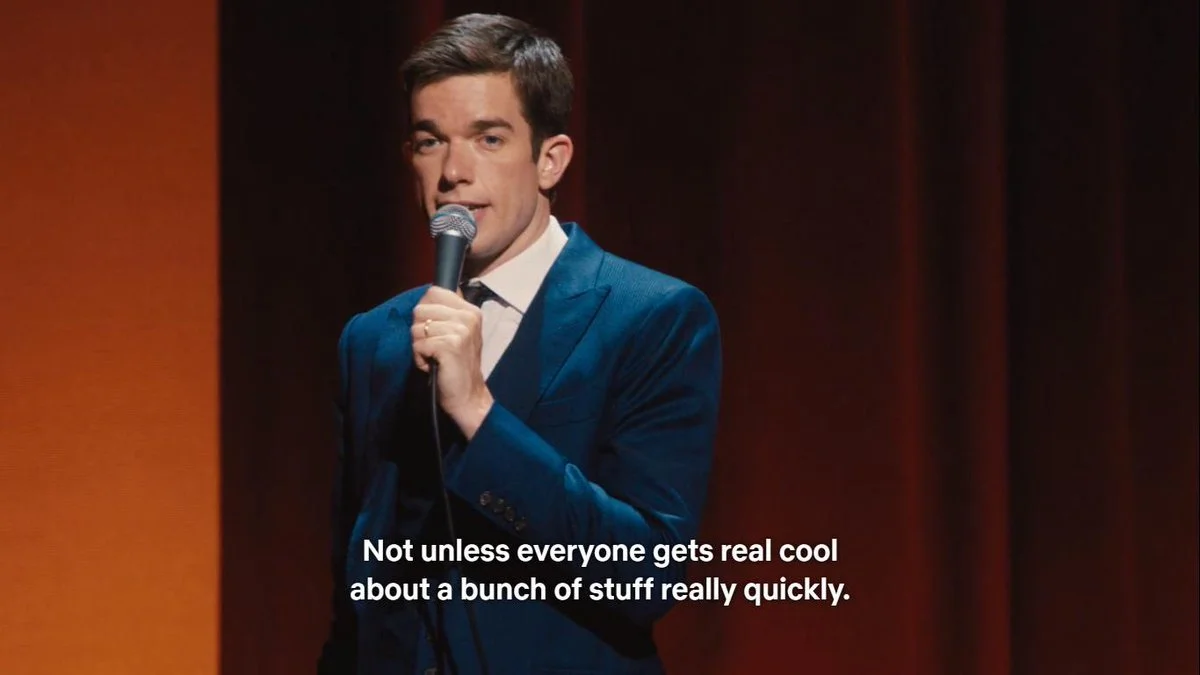
But the thing of it is, I don’t actually need to send my parents to some obscure website with built-in content tags/warnings where I publish under the same handle I’ve had since I was a moody fifteen-year-old. Nope, my articles and essays are out here, as my father would say, in front of God, the Senate, and everyone, bylined with my actual government name.
I’m not exactly hard to find. So, when I publish something but don’t get around to linking everyone in the family group chat, my parents will occasionally just go find it on their own. And read it. And then want to talk to me about it.
Which, let me be clear, is totally fine and actually very sweet. I like to think I have a pretty good relationship with my parents, and I do, in fact, enjoy talking to them about the various things we care about. My parents care about me, and I care about my writing, and sometimes we talk about those together. It’s good!
And the most recent time this happened, I got a version of a compliment from my dad that I’ve gotten from him multiple times, but it, as the kids say, just hit different. After telling me how thoughtful, engaging, and smart my writing is (thanks, Dad!), he finished up, in his self-deprecating way, by lamenting the fact that he, himself, has no discernible creativity.
Dad, I know you’re reading this, and I love you. But I’ll say now what I finally got around to saying then: creativity is a learnable skill.
And I get it. When you see someone do something you don’t know how to do yourself, it seems like magic. My husband feels this when I forget about dinner until 4:30 pm, only to turn out a full meal based entirely around what’s in the pantry and vibes. Or when I sit down with a weird stick and a piece of string, fiddle with them for several hours, then hand him a hat I crocheted. I feel this when my husband fixes the car or whips up a 3D model that he then prints out in plastic filament. Or when I watch anyone draw anything.
And while I do subscribe to Terry Pratchett’s assertion that it doesn’t cease being magic just because you know how it’s done, when you don’t know how it’s done, it seems like particularly impossible magic. So yeah. I get it.
But being a sort of magician myself, to continue the metaphor, I know that what looks like defiance of reality is just clever sleight-of-hand. I know that it’s study and practice and effort. I know that it’s a learnable skill.
Which is not to say that talent and aptitude don’t have anything to do with it. Just like anybody with enough dedication can generally learn to sink a free throw, not everybody, no matter how hard they work at it, is going to be able to play in the NBA. Likewise, just like anybody can learn to string together a pretty good paragraph or essay, not everybody is going to be good enough to be paid to do it.
And fair enough. We all have our strengths and weaknesses. It’s all part of the beautiful tapestry of humanity or whatever. Our aptitudes — our talents — are out of our control. We cannot force a natural inclination into existence within ourselves, and we are all subject to the limitations that our biology places on us. I was never going to be able to be a top-notch sprinter or notable visual artist or any number of other things, no matter how much I tried.
But I could, at a minimum, be kind of okay at them if I put in the work. Because they are learnable skills.
And even though the process of creative thinking doesn’t translate nicely to a training montage in a movie, it is no less a learnable skill than anything else in this world. Maybe it comes easier to some than others, maybe that natural inclination will elevate some to the dizzying heights of competency that others can only marvel at. But the existence of that NBA-level creativity does not mean that no one else can learn to sink a metaphorical free throw.
So, how does one learn to be more creative?
I’m not here to tell you, exactly. I’m not here to give a strict schedule to follow to “unlock your creative process” or some such nonsense. But nor am I here to tell you to submit yourself completely to the whims of “inspiration.”
If you’re genuinely serious about learning to be more creative, you really only need two things: curiosity and playfulness.
Curiosity sets the stage for creativity. “Creativity,” as we think of it, is just the result of different, single ideas or facts or bits of wisdom bumping into each other. Think of it scientifically, like a closed environment filled with gaseous atoms or perhaps a beaker with a saturated solution. The particles within those environments move around, collide with each other, form new bonds and make new molecules. The more particles you have in that closed environment, the more likely you are to get them to, you know, do that.
For our purposes here, our brains are the closed environment. If you don’t have a critical mass of ideas or facts or bits of wisdom to bump into other ones, it’s difficult to make that happen in any sort of organic way. Sure, I suppose you could forcibly introduce the only two notions you have, Hadron Collider-style, but it’s unlikely to produce the sort of results you want. Or even to work at all.
So you need to know things, understand things, have experienced things. Across a variety of subjects and disciplines. This creates a mental environment that allows ideas that normally would not meet to do so, get to know each other, fall in love and have little babies. And being curious about the world and other people and yourself is the way to do that.
Curiosity, in itself, can’t be faked. But it can be encouraged. I’m sure I don’t need to tell you about the merits of broad-based, self-directed learning. It’s no secret that everyone learns better, faster, and more effectively when they are interested in what they’re studying. And while we could get into the merits of edutainment or pop culture hooks or multi-discipline project-based learning, that’s not really the point of this particular blog post.
Think of curiosity as a flower. Some flowers are more resilient than others. Some require very specific conditions to grow and flourish, and they wilt very quickly outside of them. Some defiantly persist, even in the cracks of a sidewalk. Everyone starts with a different species of curiosity-flower, but we all have one.
We can see it in babies, as they insatiably soak in the details of this new world they’ve found themselves in. We see it in small children, in their constant explorations and demands of “Why?” and “How?” But somewhere along the line, many young people seem to lose that wild impulse that drives them to go and find out. Their curiosity-flowers have wilted. Or, at the very least, been confined to window-boxes.
It isn’t because humans naturally lose our curiosity as we age. It comes down to what and how we are taught. Have you ever been told that curiosity killed the cat? I certainly was, and more than once. It was kindly meant, intended to keep me physically safe, but the underlying lesson in the adage, as it’s usually used, is that curiosity itself can hurt us.
Our early education — all the things we learn, both in and out of a classroom — has a huge impact on how we look at the world and ourselves. And it is often filled with warnings and limitations. We’re presented lessons in tidy subject-bound boxes, as though mathematics never had anything to do with philosophy or history with science. We’re warned that a little knowledge is a dangerous thing. And that’s true, so far as it goes, but instead of an encouragement to learn more, it’s taken as a directive to not learn at all.
Stay in your lane. Focus on what’s in front of you. Maintain the current scope.
This guidance is useful, but only situationally. And applied without situational consideration, it reinforces the understanding that learning and knowledge and experience ought only to exist in neat, orderly, pre-defined spaces. It makes a mental environment of planter boxes and walled-off greenhouses instead of wild fields and blossoming meadows. Useful for focused and specific cultivation, but less so for stumbling across something genuinely new or interesting.
Curiosity is how we seed our mental soil. Or super-saturate our solutions, if you prefer. It’s how we collect all the disparate ideas inside our heads so that we can get them to bump into each other and make something new (or, at the very least, new to us). A genuinely liberal education, broad-based instead of tightly focused, can help those curiosity-flowers we’re all born with stay healthy and vibrant.
And now that you’ve indulged your curiosity and seeded your field, as it were, you need to get those little seeds to grow. You need to encourage those thoughts and ideas to bounce around and bump into each other instead of statically remaining in the orderly lines they arrived in. So how do you — to add yet another metaphor — shake the snowglobe?
Playfulness, my friend. Playfulness.
You need to put yourself into a mindset where unexpected things are permissible. You need to indulge in fun. You need to greenlight silliness. You need to embrace absurdity. Because when those ideas do start bumping into each other, they’re not going to make a whole lot of sense, at first. But automatically dismissing nonsense as such is a mistake. It is the death of the creative process.
So yes, maybe that initial combination of ideas isn’t particularly good or viable, but if you kill it in the cradle, it’s gone. If you let it be its own thing, even if you never do anything with it in that state, it can, itself, bump into yet another, different idea and become something else that’s closer to workable. You do that enough times, and suddenly, you have a bright, shiny concept that is wonderful.
This is the main point of an excellent speech given by John Cleese (which I highly recommend watching) back in 1991. That creativity is not a talent but rather a way of operating, and the people who tend to be the most creative are the ones who are the most playful.
I mentioned that humans are naturally curious, and we see that curiosity manifest most commonly and intensely in children. I don’t think it’s a coincidence that this is also where we see playfulness most commonly as well.
Maria Montessori, of Montessori schooling fame, insisted that play is the work of the child. That through play, children learn all manner of important skills, methods, and facts.
And yet, somehow, for some reason, that element of play becomes more and more excluded as children get older until the general consensus is that an adult should be serious all the time. That rigor and process are, and ought to be, mutually exclusive with fun. But this attitude doesn’t square with the mindset that actually pushes humanity forward through innovation and creative thinking.
How can a person possibly come up with a fresh idea or new way of doing things if they are unwilling to make a mistake? If they are worried about looking foolish? If they feel they lack the permission to be different?
Playfulness might appear, at first glance, to be the enemy of academic rigor. After all, engaging in play involves being wrong much of the time. But how else are we ever to arrive at what is right, or to even recognize that it is right, if we never experience how to be wrong? And how could we ever be willing to do that if it’s not allowed, either by others or by ourselves?
And this is the root of the idea that creativity is something special, reserved solely for those blessed by the Muses to shed the shackles of seriousness and responsibility that restrain all others to frolic in the fields of possibility. That creativity is for the few, not the many.
And maybe, in a lot of ways, it is. But not because it’s impossible. It’s simply that we’ve, perhaps unconsciously, set up and enforced a system that makes it hard to do.
So, we come back to the assertion that creativity is a trainable skill. Like all other trainable skills, we need to set aside time and space to practice it. This means deliberately creating the opportunity to be both curious and playful. Stepping away from the very serious business of being a grown-up.
In creative writing, this section of the story is called — not so coincidentally, in my opinion — the “fun and games” portion. Or, even more tellingly, the try-fail cycles.
All of us, all the time, are telling ourselves a story about who we are and what we are capable of doing. If that story glosses over or skips altogether the fun and games, the try-fail cycles, if it never allows space to breathe, it’s not a particularly enjoyable one, is it?
That space, that time, that play, can feel like a speed bump, like an obstacle in the way of getting somewhere else. A side quest that does nothing to advance the plot. But despite that feeling, this is how we — all of us — genuinely learn not only empirical facts but how to think about them. And, more importantly, how to think something different.
And I know these are hard to do, especially if you don’t have the natural aptitude. But so is everything you’ve never done before. And I promise, if you try, if you keep at it, if you’re determined to learn the skills, it does get easier. And you will find, more than likely, that you are far more creative than you thought you were.